
Scuba Diving in Bonaire: The Shore Diving Capital of the Caribbean
·
Quick answer
Bonaire is widely called the shore diving capital of the world. More than 60 of its 80-plus dive sites can be reached directly from the shore, each marked by a yellow-painted stone, so divers rent a pickup truck, load their tanks, and dive on their own schedule. Every diver pays an annual Marine Park nature fee that funds reef protection.
Key takeaways
- Over 60 marked dive sites are reachable straight from the shore, no boat required.
- The whole coastline is the Bonaire National Marine Park, protected since 1979.
- A Marine Park nature fee (valid for the calendar year) is mandatory for every diver.
- Gentle reef slopes close to shore make Bonaire excellent for beginners and night dives.
- Diving is good year-round, with warm water around 27C and high visibility.
Bonaire is a small island in the southern Caribbean, about 24 miles long and 5 miles wide, sitting roughly 50 miles off the coast of Venezuela. For divers it is a destination that needs little introduction. The entire coastline is a protected marine park, the reef begins a few steps from the beach, and you dive on your own timetable rather than a boat schedule. That combination is why Bonaire is so often called the shore diving capital of the world.
Why is Bonaire called the shore diving capital?
The waters around Bonaire and its uninhabited neighbor Klein Bonaire hold more than 80 dive sites, and over 60 of them can be entered directly from the shore. Each shore site is marked by a yellow-painted stone with the site name on it, so finding your entry point is simple. Because the fringing reef runs almost the whole length of the sheltered west coast, you are never far from a healthy wall of coral.
How does shore diving in Bonaire work?
The local rhythm is known as “drive and dive.” You rent a pickup truck, collect a set of filled tanks from your dive shop, and keep them in the back of the truck. When you want to dive, you drive to one of the yellow stones, park, kit up, and walk in. There is no waiting for a boat and no fixed departure time, which means you can fit in an early morning dive, a relaxed afternoon dive, and a night dive on the same reef if you want to. Most waterfront resorts sell packages with unlimited shore diving and on-site air fills.
Do you need a marine park tag?
Yes. The Bonaire National Marine Park has protected the island’s waters since 1979 and is managed by the nature foundation STINAPA. Every diver must buy a nature fee tag, valid for the calendar year, before entering the water. You can pay online in advance. Many dive operators also ask you to complete a short orientation or check-out dive so they can confirm your buoyancy and go over the rules, the most important being that you never touch or stand on the coral.
What will you see underwater?
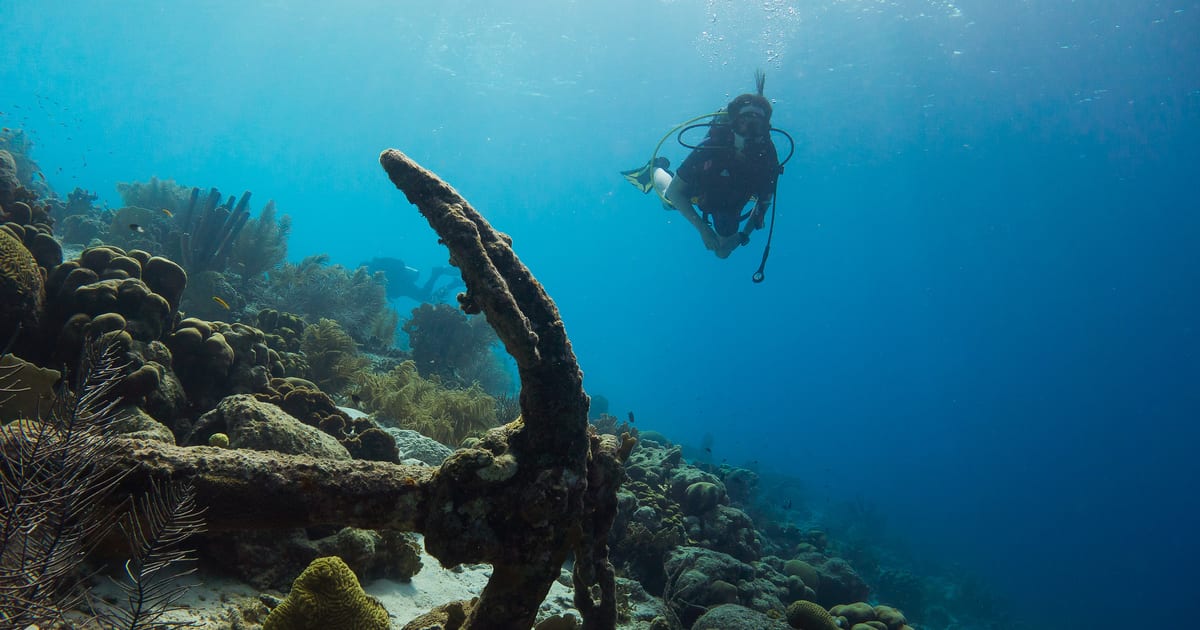
Bonaire’s reefs are famous for both their health and their variety. On a typical dive you can expect sea turtles, large schools of fish, parrotfish grazing the coral, moray eels tucked into crevices, and if you look closely, seahorses and frogfish. Some sites are known for tarpon at dusk. Bari Reef, right in front of Kralendijk, is regularly cited as one of the most fish-rich dive sites in the Caribbean.
Best dive sites for a first trip
A few sites show up on almost every itinerary. 1000 Steps is a scenic reef reached by a stone staircase down the cliff. Salt Pier, near the salt works in the south, offers dramatic light and columns covered in marine life, though access depends on shipping activity. The Hilma Hooker is a shipwreck resting on its side within recreational depths, popular with divers who want a wreck without a long boat ride. Klein Bonaire, a short water taxi away, has its own set of protected sites.
When is the best time to dive?
You can dive Bonaire in any month. Water temperature hovers around 27C year-round, and the leeward coast stays calm because the trade winds blow from the other side of the island. Bonaire sits at the southern edge of the hurricane belt, so it is less exposed to storms than much of the Caribbean, although no island is fully immune.
If you are planning a diving trip, staying close to the water saves time on every dive. Browse vacation rentals on Bonaire, many of which sit right on the shore with space to store gear and rinse tanks.
Frequently asked questions
Do I need a boat to dive in Bonaire?
No. Most diving in Bonaire is shore diving. You rent a pickup truck, load your tanks, drive to a site marked by a yellow stone, and walk in from the beach. Boat dives are available for Klein Bonaire and a few deeper sites, but they are the exception.
How much does it cost to dive in Bonaire?
Beyond gear rental and air fills, every diver must buy a Bonaire National Marine Park nature fee tag, valid for the calendar year. You can pay it online before you arrive. Prices change, so check the current rate with STINAPA, the park authority.
Is Bonaire good for beginner divers?
Yes. The reef starts close to shore and slopes gently to a drop-off, the water is calm on the leeward side, and visibility is high. Many resorts offer unlimited shore diving and open-water courses, which makes it a popular place to learn.
When is the best time to dive in Bonaire?
Bonaire dives well all year. Water temperature stays around 27C, and the island sits at the southern edge of the Caribbean, largely outside the main hurricane belt. Conditions are calmest on the west (leeward) coast.